

Table of Contents
- Why Leggings Roll Down: The Real Causes
- Signs Your Leggings Are Too Small (and What to Do)
- Waistband Design and Fabric: What Actually Holds
- DIY Fixes for Loose Waistbands and Sliding
- How to Care for Compression Leggings So They Keep Their Grip
- Best High-Performance Leggings for Workouts: What to Look For
- Frequently Asked Questions
Last Updated: September 10, 2026
Why Leggings Roll Down: The Real Causes
Learning how to prevent leggings from rolling down starts with understanding that the problem is almost never "bad leggings." It is a physics problem: your waistband is losing the fight against motion, gravity, and your own hip-to-waist ratio. At Edgefit4Us, we offer sculpt leggings and performance sets for people who train hard, with a focus on waistband mechanics. Most rolling comes down to one of three failures: the band is too loose for your hip-to-waist ratio, the fabric lacks enough elasticity to recover after stretching, or your body shape creates a gap the band can't fill.
Fit vs. Fabric: Which One Is Failing You
Fit and fabric fail differently, and the fix depends on which one is your problem. If your leggings slide down within the first ten minutes of wear, the issue is usually fit: the waistband is too large for your waist relative to your hips. If they stay put at first and start rolling an hour into a workout, that points to fabric fatigue, where the spandex (also called elastane) has stretched and lost its ability to snap back. A quick way to tell them apart: put the leggings on and walk around for five minutes. If they migrate immediately, size down or switch to a higher-compression style. If they only roll after you've been sweating and moving, the fabric is the culprit, and no amount of sizing down will fix a band that can't recover.
Signs Your Leggings Are Too Small (and What to Do)
Counterintuitively, leggings that are too small roll down just as often as ones that are too big. When a waistband is over-stretched, it can't sit flat against your body, so it curls at the top edge and rolls. Watch for these signs your leggings are too small: a visible pinch or bulge above the band, fabric that turns sheer when you squat, a gusset that pulls tight and rides up, and a waistband that leaves deep red marks after twenty minutes. Any two of these together mean you need a size up, not a tighter fit. The fix isn't to squeeze harder; it's to match the band to your actual measurements.
The Waistband Two-Finger Test
Here's a fit test you can run in the fitting room or at home in under a minute. Put the leggings on and slide two fingers flat under the front of the waistband. They should fit snugly with light resistance. If you can slide your whole hand in, the band is too loose and will slide. If you can barely wedge two fingers in and the band digs in, it's too tight and will roll at the edge. Two fingers of resistance is the sweet spot for most body types.
[American Council on Exercise guide to activewear(https://shop.edgefit4us.com/collections/activewear-example-products) fit | acefitness.org]
Waistband Design and Fabric: What Actually Holds
A waistband holds when its compression matches your body's shape and the fabric can recover its stretch. Three design elements decide whether a band stays put: band height, seam construction, and the ratio of synthetic fibers to spandex. A taller, contoured band distributes pressure over more surface area, which resists rolling better than a thin elastic strip. Flatlock seams reduce bulk that can catch and curl. And a silicone grip strip along the inner top edge adds traction against skin or a base layer. Fabric matters just as much: four-way stretch fabric with a higher spandex percentage recovers faster after each squat, lunge, or fold, while a high-polyester blend with low elastane stretches out and stays stretched.
High-Waisted vs. Mid-Waisted: Which Stays Put
High-waisted leggings stay put better than mid-waisted styles for most people, because the band sits above the natural crease of the waist where there's less flexing and folding. Mid-waisted bands land right at the point where your torso bends, so every sit-up and hinge pushes them down. If you're doing yoga or lifting, high-waisted wins. Mid-waisted can work if you have a straighter hip-to-waist ratio and prefer less coverage, but you'll need a tighter compression fit to compensate.
| Style | Best For | Rolling Risk | Coverage |
|---|---|---|---|
| High-waisted | Lifting, yoga, HIIT | Low | Full midsection |
| Mid-waisted | Casual wear, light activity | Moderate | Waist only |
| Contoured band | Curvy hip-to-waist ratios | Low | Tapered fit |
DIY Fixes for Loose Waistbands and Sliding
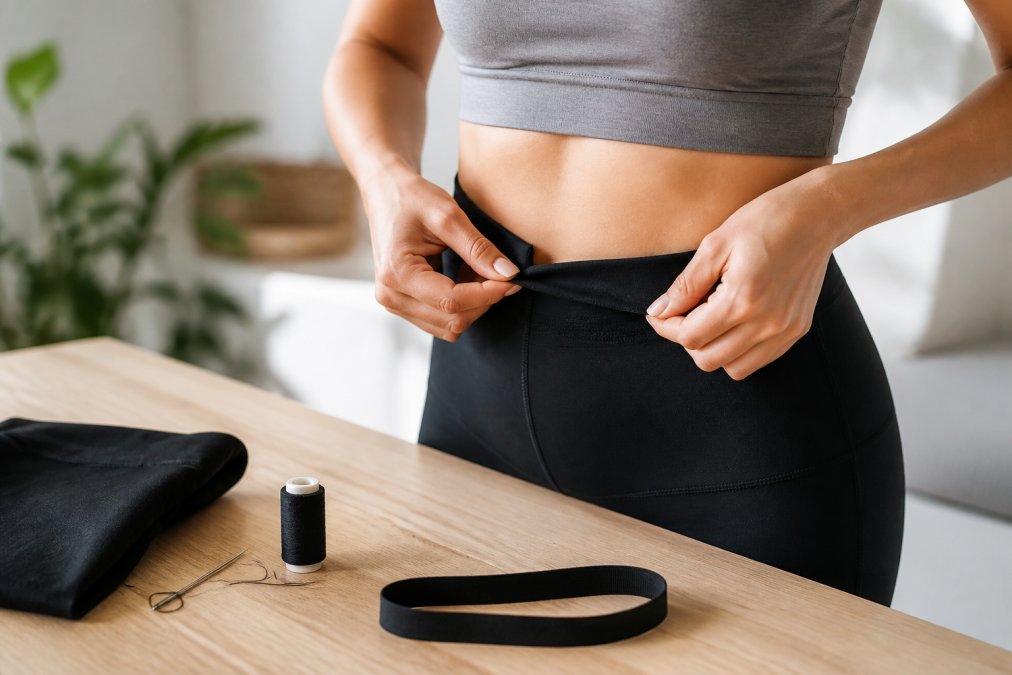
You can fix a sliding waistband without buying new leggings. These post-purchase modifications work on most activewear and take under fifteen minutes. The right fix depends on why your band is sliding, a band that is too loose needs taking in, while a band that is the right size but slick needs grip.
Fix 1: Add a Silicone Grip Strip
Best for: bands that are the right size but slide against smooth skin or a base layer.
Buy a roll of silicone hem tape (often sold as "silicone gripper tape" or "anti-slip elastic") and stitch or iron it along the inside top edge of the band. The traction holds the fabric against your skin without changing the fit. Use a narrow strip, about the top 1 centimeter of the band, rather than the full width. A narrow strip grips without creating a hard edge that digs in during forward folds. If you sew it, use a zigzag stitch so the tape can flex with the fabric instead of cracking.
Fix 2: Take In the Back Seam
Best for: bands that gap at the back because your hip-to-waist ratio is larger than the legging was cut for.
Turn the leggings inside out and pin a small dart at the center back of the waistband, then sew it shut with a stretch stitch. This tightens the band without changing the front fit, which matters if the front already sits correctly. Start with a dart no wider than 1 inch and try the leggings on before trimming, you can always take in more, but you cannot easily let it back out.
Fix 3: Thread a Drawstring
Best for: bands with an existing casing or a fold-over waist you can open.
If your band has a casing, run a flat drawstring through it and tie it snug. Many performance leggings include this for exactly this reason. If there is no casing, you can create one by folding the top edge of the band inward and stitching a channel, then threading elastic or a drawstring through it. This is the most adjustable fix because you can tighten or loosen it day to day.
Fix 4: Layer a Fitted Base
Best for: a quick fix with no sewing, especially for slick fabrics like nylon.
A thin moisture-wicking base layer under the leggings gives the band something to grip. This works best when the base layer is a smooth, fitted fabric rather than loose cotton, which can bunch and make sliding worse.
Matching the Fix to Your Body Shape
- Hourglass (defined waist, wider hips): the back-seam dart is usually the best fix, because the gap is at the back where the band cannot follow the curve of your waist.
- Athletic or straight (minimal waist definition): silicone grip strips work well, because the band has less natural curve to lock onto.
- Pear-shaped (narrow waist, wider hips and thighs): a drawstring gives you the most control, since you can cinch the waist without fighting the hip fit.
If you have tried taking in the band and adding grip and it still rolls, the fabric itself has likely lost its recovery, that is a replacement problem, not a modification problem.
How to Care for Compression Leggings So They Keep Their Grip
Elastic fatigue is the slow killer of waistbands, and how you wash and dry your leggings decides how fast it sets in. But not all compression fabrics fail the same way. The fiber blend in your leggings determines which care mistakes hurt most, so a single generic "wash cold" rule leaves performance on the table.
How Each Fiber Reacts to Heat and Washing
Spandex (elastane) is the recovery fiber, it is what snaps the waistband back after every squat. Heat is its enemy: hot water and a hot dryer break down the polymer chains that give spandex its memory, so the band stretches and never returns (textileexchange.org). This is why a single hot cycle can permanently reduce recovery.
Nylon is strong and abrasion-resistant but sensitive to chlorine and high heat. Nylon-heavy leggings hold their shape well in cold water but can yellow or stiffen if dried on high. They also pick up fabric softener residue more readily than polyester, which coats the fibers and dulls the stretch.
Polyester is the most heat-tolerant of the common performance fibers, but it is also the most prone to holding onto oils and odors. Polyester-dominant blends with low spandex content are the ones most likely to stretch out and stay stretched, because there is simply less recovery fiber to begin with. Wash these in cold water and avoid softener, which traps odor.
Cotton blends feel soft but are the worst offenders for rolling. Cotton has almost no recovery on its own, so a cotton-heavy legging relies entirely on its spandex content to hold the waistband. Cotton also absorbs water and gets heavy when wet, which pulls the band down during sweaty workouts. If your leggings are a cotton blend, air dry flat and never wring them out by the waistband.
A Care Routine That Protects Recovery
- Wash cold on a gentle cycle. Cold water protects spandex across all fiber types.
- Skip fabric softener and dryer sheets. They coat fibers and reduce elasticity, especially on nylon and polyester.
- Turn leggings inside out. This protects the outer surface, seam construction, and any silicone grip strip.
- Air dry flat. Skip the dryer entirely. Hanging by the waistband stretches it out over time, so lay them flat instead.
- Wash less often than you think. Over-washing accelerates elastic fatigue. Spot-clean and air out between wears when possible.
A quick way to check whether your care routine is working: stretch the waistband gently and let go. If it snaps back flat, recovery is intact. If it stays stretched or ripples, the elastic is already fatigued and no amount of careful washing will bring it back, that pair is a candidate for the DIY fixes above.
Best High-Performance Leggings for Workouts: What to Look For
The best high-performance leggings for workouts share a specific set of technical features. Look for four-way stretch fabric with a spandex content high enough to recover after intense movement, a contoured high waistband with flatlock seams, a gusset for freedom of movement, and moisture-wicking synthetic fibers that pull sweat away from skin. Compression level should match your activity: yoga and pilates need moderate compression for freedom of movement, while lifting and HIIT benefit from firmer support. Edgefit4Us sculpt leggings feature a contoured high waistband with performance fabric designed for high-intensity training and yoga sessions.
Textile Exchange materials and fiber guidance
A technical feature glossary helps here. Four-way stretch means the fabric stretches in all directions. Gusset is the diamond-shaped panel at the crotch that prevents ride-up. Elastic fatigue is the loss of stretch after repeated wear and washing. Traction refers to grip features like silicone strips. Fabric recovery is how well the material returns to its original shape.
Most people treat rolling leggings as a sizing problem and buy the same pair in a smaller size, which usually makes it worse. The real fix combines the right fit, a contoured waistband, and fabric that recovers its stretch. Edgefit4Us offers sculpt leggings and high-performance sets with a contoured high waistband, four-way stretch fabric, and flatlock seam construction. Explore the Edgefit4Us collection and find gear designed to support your active lifestyle.
Frequently Asked Questions
Why do my leggings roll down when I walk?
Leggings roll down when the waistband can't grip your body through movement. Common causes include a waistband that's too loose, fabric with poor elasticity recovery, or a rise that doesn't match your hip-to-waist ratio. Compression fabric with four-way stretch and a wide, structured waistband resists this. If rolling starts within minutes of walking, the fit or fabric is the problem, not your body.
Does sizing up or down help prevent leggings from rolling?
Sizing down rarely fixes rolling and usually makes it worse by causing the fabric to push downward as it stretches. Sizing up can help if the waistband is cutting in, but only when the rise and hip fit are correct. The real test is the waistband: it should sit flat with light compression and pass the two-finger test. Check signs your leggings are too small first, like visible strain lines or a waistband that leaves deep marks.
Are high-waisted leggings more prone to rolling down?
High-waisted leggings roll down only when the waistband lacks structure or the fabric has lost elasticity. A well-constructed high-waisted pair with a wide, bonded waistband and silicone grip actually stays put better than mid-rise because it anchors above the hip bone. The tradeoff is heat and compression, so choose based on activity. For yoga and lifting, high-waisted with four-way stretch is the safer bet.
How can I tell if my leggings are the wrong size?
Check three things: the waistband should not gap when you bend sideways, the fabric should not turn sheer when you squat, and the seams should not pull or pucker. If you can pinch more than two fingers of fabric at the waist, they're too big. If the waistband digs in and leaves red marks after 20 minutes, they're too small. Both extremes cause sliding and rolling during movement.